VA Assumable Homes for Sale: The Low-Rate Opportunity Most Buyers Miss
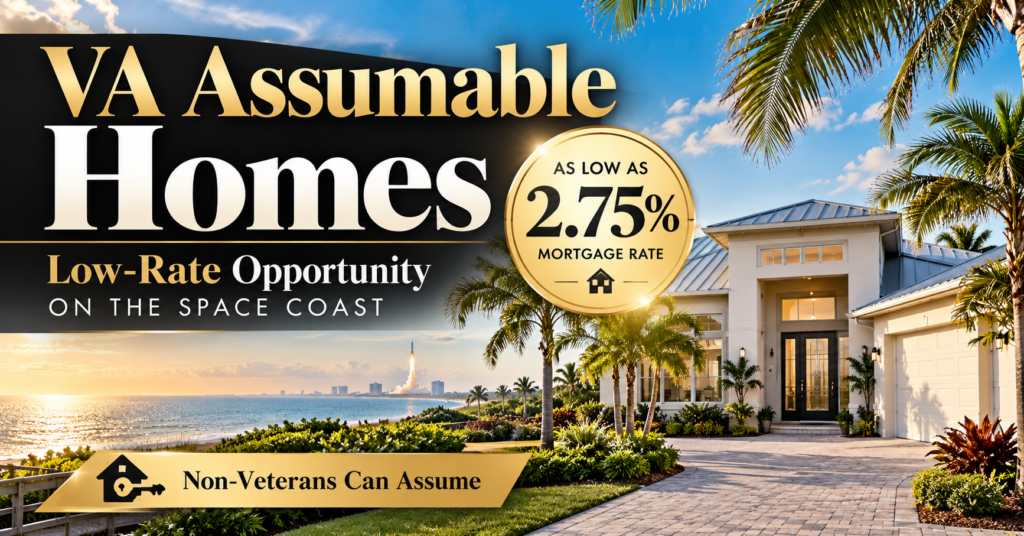
Did You Know? You Don’t Have to Be a Veteran to Assume a VA Loan
One of the most overlooked opportunities in today’s housing market is hiding in mortgages that were originated several years ago.
A qualified buyer does not have to be a Veteran to assume an existing VA mortgage.
That matters because many homeowners who purchased or refinanced during 2020 and 2021 locked in mortgage rates that simply aren’t available today.
Freddie Mac reported that the average 30-year mortgage rate reached a historic low of 2.65% in January 2021. As of September 24, 2026, the average 30-year fixed mortgage rate was 7.03%.
Those old mortgages didn’t disappear.
Some of them are attached to homes currently for sale.
And in the right situation, a buyer may be able to take over the seller’s existing VA mortgage—including its interest rate, remaining balance and remaining loan term—instead of obtaining an entirely new mortgage.
I’m currently working with a buyer on a VA loan assumption where the existing mortgage rate is 2.75%.
That gets people’s attention pretty quickly.
Search VA Assumable Homes for Sale on the Space Coast
(Includes FHA Assumables as well)
Not every listing marketed as assumable will ultimately qualify, and the terms of the existing mortgage need to be verified. But this search can help identify properties worth investigating.
Want to Search Assumable Homes by Area?
I also break out current assumable mortgage listings by major Brevard County areas, including Satellite Beach & Indian Harbour Beach, Cocoa Beach & Cape Canaveral, Indialantic & Melbourne Beach, Melbourne, Palm Bay, and Viera.
Browse assumable homes by area →
If you see one you’re interested in, I can help determine what loan is actually attached to the property, approximately how much remains on it and what the financial structure of an assumption could look like.
How a VA Loan Assumption Works
Instead of applying for a brand-new mortgage for the entire purchase price, the buyer applies to take responsibility for the seller’s existing VA loan.
For VA loans originated after March 1, 1988, the assumption generally must be approved by the loan holder, servicer or VA.
The existing loan must be current, and the buyer must meet VA credit and income underwriting requirements.
VA specifically states that any qualified purchaser—including a non-Veteran—may assume the remaining balance of a VA-guaranteed loan. I break that misconception down in more detail in Can a Civilian Assume a VA Loan?
So there are really two separate questions:
Can the buyer qualify to assume the mortgage?
and
How will the buyer cover the difference between the mortgage balance and the purchase price?
That second question is usually the biggest hurdle.
The Equity Gap: The Part Buyers Need to Understand
An assumption doesn’t mean you finance the home’s entire purchase price at the seller’s old interest rate.
You are assuming the remaining mortgage balance.
The difference between that balance and the purchase price is commonly called the equity gap. For a deeper breakdown of how much cash may actually be needed, see my VA Loan Equity Gap guide.
For example:
Purchase price: $375,000
Remaining assumable VA mortgage: approximately $250,000
Equity gap: approximately $125,000
The buyer still has to cover that approximately $125,000 difference, plus applicable closing costs.
That money could potentially come from cash, proceeds from another sale or—in some transactions—additional financing.
That is why an assumable mortgage with a fantastic rate isn’t automatically a fantastic deal.
The entire financial structure has to work.
Why the Equity Gap Can Still Be Worth Solving
Consider the mortgage itself.
A $250,000 mortgage amortized over 30 years at 2.75% has principal and interest of roughly $1,021 per month.
The same $250,000 financed for 30 years at 7.03% would be roughly $1,668 per month.
That’s a difference of approximately $647 per month in principal and interest.
The actual comparison for an assumable mortgage will depend on the remaining balance and remaining term of the existing loan, but it shows why these properties deserve a closer look.
Sometimes solving the equity gap can unlock a mortgage that would be impossible to recreate in today’s market.
Do You Have to Be a Veteran to Assume a VA Mortgage?
No.
This is probably the biggest misconception surrounding VA assumptions.
The Department of Veterans Affairs explicitly allows a qualified non-Veteran buyer to assume a VA-guaranteed mortgage.
The buyer still has to qualify financially and receive approval for the assumption.
Where Veteran status becomes especially important is with something called Substitution of Entitlement.
What Happens to the Seller’s VA Entitlement?
This part is extremely important—especially for the Veteran selling the property.
A normal release of liability and a restoration of VA entitlement are not necessarily the same thing.
If a qualified non-Veteran assumes the mortgage and the assumption is properly approved, the Veteran seller can generally be released from responsibility for making the mortgage payments.
However, the Veteran’s VA entitlement used to guarantee that loan generally remains tied to the mortgage until the loan is paid off.
That can affect how much VA entitlement the seller has available for another VA-backed purchase. I explain the release-of-liability versus restoration issue in VA Loan Entitlement After Assumption.
Substitution of Entitlement
If the buyer is also an eligible Veteran, there may be another option.
The Veteran buyer may be able to substitute his or her own VA entitlement for the seller’s entitlement.
For a Substitution of Entitlement, the buyer generally must:
Be eligible for a VA Certificate of Eligibility.
Have enough available entitlement to replace the amount originally used by the seller.
Qualify for the assumption.
Intend to occupy the property as a primary residence.
Agree to substitute their entitlement for the seller’s.
If approved, the selling Veteran’s entitlement can then be restored.
This is one reason a Veteran-to-Veteran assumption can be particularly attractive to the seller.
But again, the buyer does not have to be a Veteran simply to assume the VA loan.
VA Loan Assumption vs. Substitution of Entitlement
Think of them as two separate transactions happening together.
Loan Assumption
The buyer takes responsibility for the existing mortgage.
The buyer may be a Veteran or a non-Veteran.
Substitution of Entitlement
An eligible Veteran buyer substitutes their VA entitlement for the selling Veteran’s entitlement.
This can free the seller’s entitlement for future use.
A non-Veteran can complete the first part, but can’t complete the second.
What Happens During the VA Assumption Process?
Every servicer handles the logistics a little differently, but the basic process generally looks like this:
Identify the existing VA mortgage.
Confirm the loan is actually assumable and obtain the approximate loan balance, interest rate, payment and remaining term.Determine the equity gap.
Compare the agreed purchase price with the remaining assumable loan balance.Structure the purchase.
Determine how the buyer will cover the equity gap and closing costs.Apply with the existing mortgage servicer.
The buyer submits financial information similar to a traditional mortgage application.Buyer underwriting.
The buyer must satisfy VA credit and income underwriting standards.Determine whether Substitution of Entitlement applies.
If the buyer is an eligible Veteran and the parties want the seller’s entitlement restored, that process is handled as part of the assumption.Obtain assumption approval and release of liability.
Close the sale and transfer ownership.
VA guidance currently requires servicers with automatic assumption authority to decide a complete application within 45 calendar days. Different procedures apply when the servicer does not have automatic authority and VA prior approval is required.
This is not the same process as getting a normal purchase mortgage, which is why it helps to identify an assumable-loan opportunity early rather than trying to figure everything out a week before closing. For a side-by-side look at timing, fees, funding costs and when each option makes sense, see VA Loan Assumption vs. New VA Loan.
Are There Fees for Assuming a VA Loan?
Yes.
VA assumptions can involve servicing, closing and recording costs, and VA generally charges an assumption funding fee unless the borrower qualifies for an exemption.
The exact costs should be confirmed with the mortgage servicer before structuring the transaction.
The important comparison isn’t simply whether an assumption has fees.
It’s whether the total cost of obtaining the assumable mortgage makes sense compared with financing the same home at today’s available mortgage terms.
Not Every “Assumable” Listing Is the Same
This is another reason I don’t recommend treating the word assumable in an MLS description as the end of the research.
Before getting too excited, I want to know:
What type of loan is it?
What is the actual interest rate?
What is the remaining principal balance?
How many years remain on the mortgage?
What is the monthly principal and interest payment?
Are there any second mortgages, HELOCs or other liens?
How large is the equity gap?
Will the servicer approve the assumption?
Is the seller expecting a Substitution of Entitlement?
How will the buyer fund the equity gap?
A 2.75% assumable mortgage can be extremely valuable.
A 2.75% mortgage with a $200,000 equity gap that the buyer can’t fund isn’t.
The numbers have to work together.
Why VA Assumable Homes Are Worth Watching Now
We haven’t seen the mortgage-rate environment of 2020 and 2021 for about five years.
A large number of homeowners still hold mortgages created during that historically low-rate period.
Freddie Mac has described this as the mortgage “lock-in effect”: homeowners holding very low mortgage rates have a financial incentive to keep those loans rather than replace them with significantly more expensive financing.
An assumable VA mortgage creates a rare exception.
Instead of the low-rate mortgage disappearing when the owner sells, a qualified buyer may be able to take it over.
That’s why I think assumable mortgages deserve to be treated as their own home-search category—not just as an interesting line buried in an MLS listing.
If you are trying to buy again before a current VA-financed home sells, the entitlement question may matter just as much as the assumable rate. See Can You Buy Before Selling With Remaining VA Entitlement? for the partial-entitlement and county-limit math.
Related VA Assumption Guides
If you want to go deeper on a specific part of the transaction, these supporting guides break out the questions that come up most often:
- VA Loan Equity Gap: How Much Cash Do You Need?
- VA Loan Entitlement After Assumption: What Happens?
- Can a Civilian Assume a VA Loan?
- VA Loan Assumption vs. New VA Loan: Which Is Better?
- Can You Buy Before Selling With Remaining VA Entitlement?
Want Me to Run the Numbers on an Assumable Home?
If you find an assumable property on the Space Coast, send it to me.
I’ll help you look beyond the marketing language and break down:
Purchase price → existing mortgage balance → equity gap → remaining loan terms → assumption considerations.
Sometimes the numbers won’t make sense.
Sometimes they absolutely will.
And with older VA mortgages carrying rates in the 2% and 3% range, it’s worth doing the homework before automatically replacing that mortgage with a new one.