Buying Before Selling With Remaining VA Entitlement
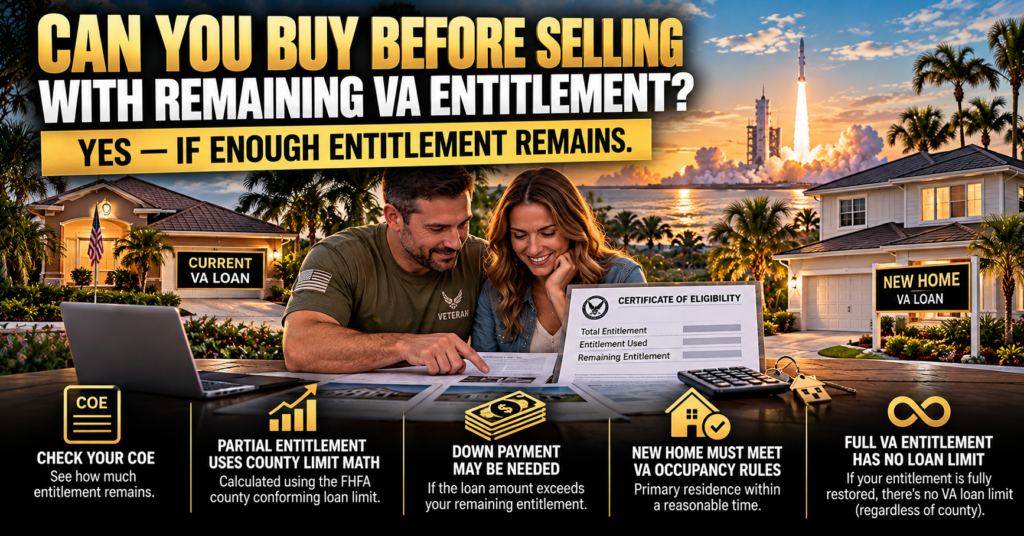
Short answer: yes, you may be able to buy before selling with remaining VA entitlement. If you still have enough unused entitlement—and you qualify with the lender—you can potentially keep your current VA-financed home and use remaining entitlement for another VA-backed purchase.
The catch is that once entitlement is already tied to an existing VA loan, county conforming loan limits come back into the calculation. Full entitlement has no VA county loan limit. Partial or unrestored entitlement does.
So the right question is not simply, ‘Can I have two VA loans?’ It is: How much entitlement is already charged, how much remains, what is the conforming loan limit where I am buying, and will I need a down payment to make up any guaranty shortfall?
Can You Buy Before Selling With Remaining VA Entitlement?
Yes. VA has confirmed that in many cases a Veteran can keep a current VA-backed home and use remaining entitlement to buy another home that will become the Veteran’s primary residence.
That can be especially useful for PCS moves, job transfers, family changes, or situations where selling first would create unnecessary timing pressure.
But the borrower still has to qualify for the new loan while carrying the existing mortgage, and the amount of remaining entitlement may affect whether a down payment is required.
What Is Remaining VA Entitlement?
When you use a VA loan, part of your VA guaranty entitlement is charged to that loan.
If the loan is still outstanding and the entitlement has not been restored, you may still have remaining entitlement available for another VA-backed mortgage.
Your current Certificate of Eligibility, or COE, shows the entitlement already charged to prior VA loans. That number is the starting point for the calculation.
VA’s current guidance explains that Veterans with full entitlement do not have a county loan limit. Veterans with partial or unrestored entitlement use the applicable FHFA one-unit conforming loan limit to calculate how much guaranty remains available.
Step 1: Check Your Current Certificate of Eligibility
Before trying to guess how much house you can buy, pull an updated COE.
Look for the section showing prior loans charged to entitlement. That tells you how much entitlement is currently tied to another VA loan.
You can request a COE through VA or have a VA-approved lender retrieve it.
This is why I tell buyers not to start with a random online ‘VA maximum loan’ calculator. If you have partial entitlement, your own COE matters.
Step 2: Find the County Conforming Loan Limit Where You Want to Buy
For partial entitlement, VA uses the FHFA one-unit conforming loan limit for the county where the new property is located.
For 2026, the one-unit conforming loan limit in Brevard County, Florida is $832,750.
Multiply that county limit by 25% to determine the maximum guaranty amount used in the remaining-entitlement calculation.
- 2026 one-unit conforming limit: $832,750
- 25% of that amount: $208,187.50
Step 3: Subtract the Entitlement Already Charged
Now subtract the entitlement already tied to your current VA loan from that 25% county-limit figure.
Example:
- Brevard County guaranty ceiling for the calculation: $208,187.50
- Entitlement already charged on your existing VA loan: $100,000
- Remaining entitlement: $108,187.50
Multiply the remaining entitlement by four and you get a rough picture of how much loan most lenders could potentially support without a down payment based on guaranty alone.
In this example, $108,187.50 × 4 = $432,750.
That is not a VA ‘loan limit.’ It is simply the point at which the available guaranty would typically cover 25% of the new loan.
What If the New Purchase Is Higher Than the Remaining Entitlement Supports?
You may still be able to buy the home.
Most lenders generally want the combination of VA guaranty plus the borrower’s down payment to equal at least 25% of the loan amount.
Using the same example, suppose the new loan amount is $500,000.
- 25% of $500,000 = $125,000
- Remaining entitlement = $108,187.50
- Guaranty shortfall = $16,812.50
That shortfall may translate into a required down payment of about $16,812.50, subject to the lender’s calculation, appraisal, sales price, and underwriting.
That is very different from saying, ‘You can’t use VA again until you sell.’
Can You Have Two VA Loans at the Same Time?
Yes, in some situations.
VA’s own guidance recognizes that a Veteran can have an existing VA-backed mortgage and use remaining entitlement for another VA purchase.
The new property must satisfy VA occupancy requirements and become the Veteran’s residence within a reasonable time.
The lender also has to be comfortable that the borrower can qualify while carrying both obligations.
Occupancy Still Matters
A second VA-backed purchase is not a way to build a portfolio of non-owner-occupied investment properties.
The new home generally needs to become your primary residence under VA occupancy rules.
The existing property may later become a rental, depending on the circumstances and loan terms, but the new VA purchase itself still has to meet the occupancy requirement.
Qualifying With Both Mortgage Payments
Entitlement is only one side of the equation.
You still need to qualify financially for the new mortgage.
The lender will evaluate income, debts, residual income, credit, and how the existing property is treated in underwriting.
If the current home will be rented, the lender may be able to consider qualifying rental income under its guidelines—but do not assume the full future rent simply cancels out the existing mortgage payment.
This is where lender-specific underwriting matters.
What Happens After You Sell the Old Home?
If the old property is sold and the VA loan is paid in full, you can generally request restoration of the entitlement that had been tied to that loan.
Once full entitlement is restored, the county-limit calculation described above no longer applies in the same way. Veterans with full entitlement have no VA-imposed county loan limit, although lender approval and appraisal still control how much can actually be borrowed.
What If Someone Assumes Your Existing VA Loan?
An assumption does not automatically restore the seller’s entitlement.
If a qualified Veteran buyer assumes the loan and substitutes sufficient VA entitlement, the seller may be able to restore the entitlement tied to that mortgage.
If a civilian assumes the loan—or a Veteran assumes it without approved substitution—the seller may receive a release of liability while the entitlement remains tied to the loan.
That matters enormously if the seller wants to use VA financing again.
See my VA Loan Entitlement After Assumption guide and Can a Civilian Assume a VA Loan? for the full breakdown.
Buying Before Selling Near Patrick Space Force Base
This strategy can be useful for military and Veteran buyers around Patrick Space Force Base and Florida’s Space Coast.
A family may be moving into Satellite Beach, South Patrick Shores, Indian Harbour Beach, Cocoa Beach, Melbourne, West Melbourne, Viera, Palm Bay, or another Brevard County community while still owning a VA-financed home elsewhere.
Sometimes waiting for the old home to sell first is the cleanest solution. Other times, remaining entitlement lets the family secure the right new home before the old transaction is finished.
The answer depends on the COE, the entitlement already used, the county limit where the new home is located, the buyer’s available cash, and the lender’s debt-to-income and residual-income analysis.
For the broader relocation picture, see my Patrick SFB and Space Coast Military Relocation Guide.
How Remaining Entitlement Interacts With an Assumable VA Home
This is where things can get especially interesting.
A Veteran with partial entitlement may be able to:
- Use remaining entitlement for a brand-new VA loan
- Assume another VA loan and potentially substitute entitlement if enough is available
- Assume a VA loan without substitution, leaving the seller’s entitlement attached
- Choose a conventional or other loan instead if the entitlement math does not work
The loan with the lowest rate is not automatically the best structure.
Compare the entitlement consequence, equity gap, cash to close, monthly payment, and what happens to the seller’s VA benefit.
For that comparison, see VA Loan Assumption vs. New VA Loan: Which Is Better?.
Frequently Asked Questions About Buying Before Selling With VA Entitlement
Do I have to sell my current VA-financed home before buying another?
No. If you have enough remaining entitlement and qualify financially, you may be able to purchase another primary residence with a VA-backed loan before selling the current home.
Is there a VA loan limit when I have remaining entitlement?
VA does not set a maximum loan amount, but county conforming loan limits are used to calculate the available guaranty when entitlement is partial or unrestored. That can create a down-payment requirement on a larger new loan.
Does full VA entitlement have a county loan limit?
No. Veterans with full entitlement do not have a VA-imposed county loan limit. The lender still has to approve the loan and the appraisal must support the transaction.
Can I keep my old house as a rental?
Potentially. The new VA-financed property must satisfy occupancy requirements, and the lender will decide how the existing home and any rental income are treated for underwriting.
How do I know how much entitlement I have left?
Request an updated Certificate of Eligibility and review the entitlement charged to prior loans. Then compare that amount against 25% of the one-unit conforming loan limit for the county where you want to buy.
What restores my full entitlement?
Common restoration paths include selling the prior property and paying off the VA loan, an eligible Veteran assuming the loan with approved substitution of entitlement, or—in a one-time situation—paying off the prior VA loan while keeping the property.
Should You Buy Before Selling?
Sometimes yes.
If the right home comes along before your existing VA-financed property sells, remaining entitlement can give you options that many buyers—and plenty of agents—do not realize exist.
But do not guess from the old loan balance alone.
Pull the COE, calculate the remaining entitlement, run the new county-limit math, and let the lender confirm the guaranty and down-payment requirement.
If you are trying to buy on Florida’s Space Coast before your current home sells, send me the scenario. I can help organize the property, timing, entitlement, and real-estate side of the decision so your lender can confirm the financing.
Need to Buy Before Your Current Home Sells?
Let’s Check the Entitlement Math Before You Rule It Out.
Send me the current VA loan and the home you are considering. I’ll help organize the entitlement, timing, and property questions so your lender can confirm the financing.
Call or text: 321-914-2347