
Understanding VA Loan Entitlement After Assumption
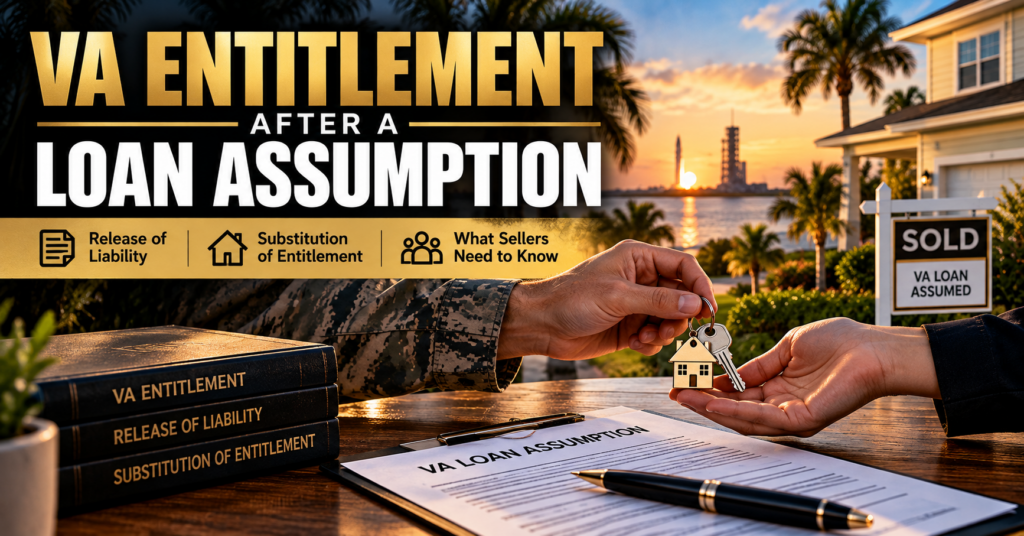
Short answer: VA loan entitlement after assumption depends on whether the buyer simply assumes the mortgage or also substitutes their own VA entitlement for the seller’s. A seller can receive a release of liability and still have VA entitlement tied to the loan.
That distinction matters because a Veteran seller may leave closing no longer responsible for the monthly payment, yet still have some of their VA home loan entitlement unavailable for another purchase.
In other words: getting off the loan is not automatically the same thing as getting your entitlement back.
For the full mechanics of VA assumptions, start with my VA Assumable Homes for Sale guide. This article focuses specifically on what happens to the seller’s VA entitlement.
What Is VA Loan Entitlement?
VA loan entitlement is the portion of your VA home loan benefit used to help guarantee a VA-backed mortgage.
Your Certificate of Eligibility, or COE, shows your entitlement information. When you use a VA loan, some entitlement is generally tied to that loan until it is restored or otherwise released under VA rules.
That is why a seller considering a VA loan assumption should ask two separate questions:
- Will I be released from liability for the mortgage?
- Will my VA entitlement be restored?
Those are related questions, but they are not the same question.
VA Loan Entitlement After Assumption Without Substitution
If a qualified buyer assumes the VA loan and the assumption is properly approved, the seller may receive a release of liability.
That means the buyer becomes responsible for the mortgage obligation.
But if the buyer does not substitute VA entitlement for the seller’s, the original Veteran’s entitlement generally remains tied to the loan until that loan is paid in full.
VA’s assumption guidance is direct on this point: an assumption may be processed with or without a substitution of entitlement. Without substitution, the seller does not receive restoration of the entitlement tied to that loan.
See the VA assumption guidance.
Release of Liability vs. Restoration of VA Entitlement
This is the most important distinction in the entire process.
Release of Liability
A release of liability means the seller is released from personal responsibility for the assumed VA mortgage after the qualified assumption is approved.
That protects the seller from being treated as the borrower responsible for future payments on that loan.
Restoration of Entitlement
Restoration of entitlement means the VA benefit previously used on that loan becomes available again, subject to VA eligibility rules.
A release of liability does not by itself restore VA entitlement.
A seller can have one without the other.
What Is Substitution of Entitlement?
Substitution of Entitlement is the process that may allow an eligible Veteran buyer to substitute their own VA entitlement for the seller’s entitlement when assuming the loan.
According to VA guidance, the buyer generally needs to:
- Be eligible for VA home loan benefits
- Have enough available entitlement to replace the amount used by the seller
- Qualify for the assumption
- Meet applicable occupancy requirements
- Agree to substitute their entitlement for the seller’s
If VA approves the substitution, the seller’s entitlement tied to that loan can be restored.
This is why a Veteran-to-Veteran assumption can be especially attractive to a Veteran seller who wants to preserve the ability to use a VA loan again.
Can a Non-Veteran Assume the Loan and Restore the Seller’s Entitlement?
A qualified non-Veteran can assume a VA-guaranteed mortgage.
But a non-Veteran does not have VA entitlement to substitute for the seller’s.
So while the seller may receive a release of liability through the approved assumption, the entitlement used on that loan generally remains tied up until the loan is paid in full or another qualifying restoration event occurs.
This is one reason the buyer’s Veteran status matters much more to the seller than many buyers realize.
Can the Seller Still Use a VA Loan Again?
Possibly.
Having entitlement tied to an assumed loan does not automatically mean the seller can never use a VA loan again.
A Veteran may still have remaining entitlement available for another VA-backed purchase. The amount depends on the entitlement already charged to the existing loan, the Veteran’s COE, the new property location, loan amount, and lender calculations.
VA specifically notes that if full restoration is not available, a Veteran may still have remaining entitlement.
That means the correct next step is not to guess. Check the COE and have the new lender calculate what is available for the next purchase.
Example: Assumption by a Non-Veteran Buyer
Suppose a Veteran sells a home with a $300,000 VA loan balance carrying a very low interest rate.
A qualified civilian buyer assumes the loan.
- The assumption is approved.
- The seller receives a release of liability.
- The civilian buyer takes responsibility for the mortgage.
- The seller’s VA entitlement used on that loan generally remains tied to the loan.
The seller is off the debt, but the entitlement is not automatically restored.
Example: Veteran Buyer Substitutes Entitlement
Now use the same basic transaction, except the buyer is an eligible Veteran with sufficient available entitlement.
The Veteran buyer qualifies for the assumption and agrees to substitute their entitlement for the seller’s.
- The assumption is approved.
- The seller receives a release of liability.
- The buyer substitutes sufficient VA entitlement.
- The seller’s entitlement tied to the loan may be restored.
That can give the seller much more flexibility for a future VA purchase.
How Much Entitlement Does the Buyer Need to Substitute?
The buyer needs enough available entitlement to replace the amount of entitlement originally charged to the seller for that VA loan.
This is not necessarily the same as the current mortgage balance.
VA guidance uses the amount of entitlement originally used as the key comparison. If the buyer does not have enough available entitlement, substitution may not be possible.
That is why both the buyer’s and seller’s COEs can become important early in the process.
What If the Buyer Does Not Have Enough VA Entitlement?
If the Veteran buyer cannot substitute enough entitlement, the assumption may still potentially proceed as an assumption without substitution, assuming all other requirements are satisfied.
But the seller’s entitlement would generally remain encumbered by the loan.
That may be perfectly acceptable to some sellers and a deal-breaker for others.
The answer depends on what the seller plans to do next.
Why Sellers Should Decide Their Entitlement Goal Before Accepting an Assumption
An assumable mortgage can be a strong selling feature, especially when the existing rate is far below current mortgage rates.
But a Veteran seller should decide early whether restoring VA entitlement is important.
If the seller expects to buy another home with VA financing soon, substitution of entitlement may be a major part of the negotiation.
If the seller is retiring from homeownership, moving into a cash purchase, or has plenty of remaining entitlement, restoration may be less important.
The point is to understand the consequence before closing, not six months afterward.
VA Loan Entitlement and the Equity Gap
Seller entitlement and the buyer’s equity gap are separate issues, but both can affect whether an assumption works.
The equity gap is the difference between the purchase price and the remaining assumable mortgage balance.
A buyer may have enough VA entitlement for substitution and still struggle to fund the equity gap.
Likewise, a buyer may have plenty of cash for the equity gap but no VA entitlement to substitute.
For the cash side of the transaction, see my VA Loan Equity Gap guide.
VA Loan Entitlement After Assumption Near Patrick SFB
This issue can be especially relevant around Patrick Space Force Base and the Space Coast, where military moves often involve one VA-financed home followed by another duty-station purchase.
A seller leaving Brevard County may want their entitlement restored for the next PCS. A Veteran buyer arriving at Patrick may have entitlement available to substitute. A civilian buyer may still be able to assume the loan, but without solving the seller’s entitlement issue.
Those details can affect which buyer is actually the best fit for an assumable property.
For the bigger relocation picture, see my Military Relocation Guide for Patrick SFB and Florida’s Space Coast.
Frequently Asked Questions About VA Loan Entitlement After Assumption
Does a release of liability restore VA entitlement?
No. A release of liability and restoration of entitlement are separate. The seller may be released from the mortgage obligation while the entitlement remains tied to the loan.
Can a civilian assume a VA loan?
Yes. A qualified non-Veteran may assume a VA-guaranteed mortgage, but they cannot substitute VA entitlement because they do not have VA entitlement to substitute.
Can a Veteran buyer restore the seller’s entitlement?
Potentially. If the buyer is eligible, has enough available entitlement, meets the requirements, and VA approves the substitution, the buyer’s entitlement can replace the seller’s.
Can I still buy another home with a VA loan if my entitlement is tied up?
Possibly. You may still have remaining entitlement available. Your COE and the lender’s entitlement calculation determine what options are available for the next purchase.
When is VA entitlement fully restored after an assumption?
In a qualifying assumption with approved substitution of entitlement, the seller’s entitlement tied to the loan may be restored. Otherwise, entitlement generally remains tied to the loan until it is paid in full or another qualifying restoration event occurs.
Planning to Sell a Home With an Assumable VA Loan?
The low interest rate may attract buyers. The entitlement question determines what the assumption means for you after closing.
Before treating an assumption as the obvious answer, I want to know:
- Who is assuming the loan?
- Will the seller receive a release of liability?
- Is the buyer eligible for substitution of entitlement?
- Does the buyer have enough entitlement?
- Does the seller need that entitlement for the next purchase?
- Can the buyer handle the equity gap?
The rate matters.
The entitlement matters too.
If you are buying or selling an assumable home on Florida’s Space Coast, I can help organize the real estate side of those questions so the lender and servicer can verify the loan-specific details.
Selling With an Assumable VA Loan?
Know What Happens to Your Entitlement Before You Close.
I’ll help you identify the real estate questions that need answers before an assumption moves forward, including the equity gap and whether substitution of entitlement matters to the seller.
Call or text: 321-914-2347