
VA Loan Assumption vs. New VA Loan: Cost, Time & Which Is Better?
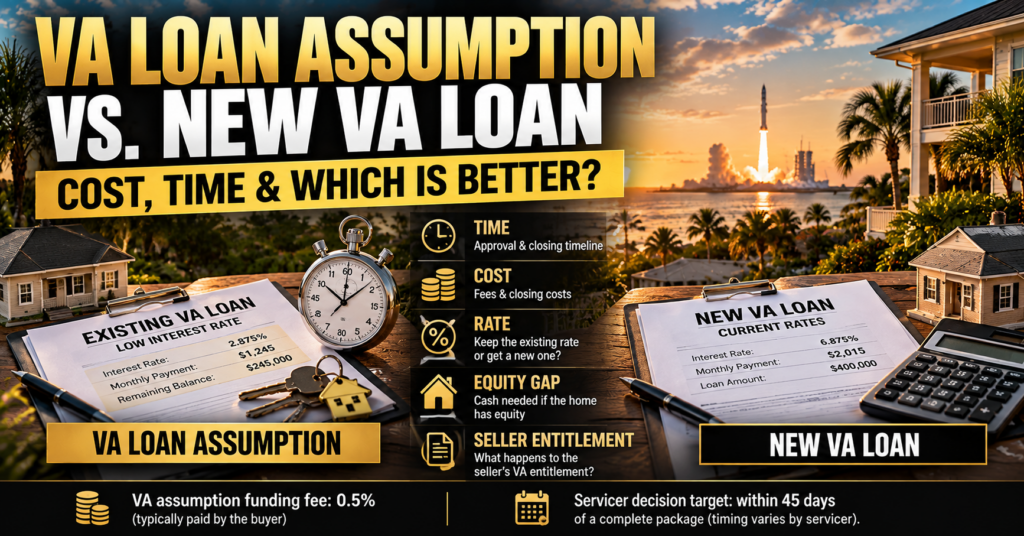
Short answer: a VA loan assumption vs. new VA loan comparison comes down to more than the interest rate. An assumption can offer a much lower existing rate and a lower 0.5% VA funding fee, but it can also take longer, require a large equity gap, and create seller-entitlement issues. A new VA loan is usually more straightforward, can finance a larger share of the purchase, and may close on a more familiar lender timeline—but at today’s market rate and with a higher purchase-loan funding fee unless the borrower is exempt.
There is no automatic winner. The better option is the one that produces the strongest combination of cash to close, monthly payment, timeline, and long-term flexibility.
For the broader mechanics of assumptions, start with my VA Assumable Homes for Sale guide.
VA Loan Assumption vs. New VA Loan: Quick Comparison
- Interest rate: Assumption keeps the existing loan rate; new VA loan uses current market pricing.
- VA funding fee: Assumption is generally 0.5% of the assumed loan balance unless exempt; new VA purchase-loan funding fees vary by first/subsequent use and down payment.
- Timeline: VA requires certain assumption decisions within defined windows, but the 45-day rule is a decision deadline after a complete package—not a guarantee that the entire transaction closes in 45 days.
- Equity gap: Assumption may require substantial cash or approved secondary financing above the remaining loan balance.
- Seller entitlement: A non-Veteran assumption can leave the seller’s VA entitlement tied to the loan.
- Flexibility: A new VA loan is built around the new purchase price rather than an old remaining balance.
How Long Does a VA Loan Assumption Take?
This is where expectations need to be realistic.
If the current holder or servicer has automatic authority, VA says the servicer should make an assumption decision within 45 calendar days after receiving a complete assumption application package. If the holder does not have automatic authority, the servicer generally must submit the package to VA within 35 calendar days.
Those are processing requirements—not promises that keys are handed over on day 45.
Closing can take longer because the file still has to move through document collection, underwriting, title work, payoff and balance verification, insurance, possible secondary financing, seller-entitlement documentation, and closing coordination.
VA has specifically warned servicers about failing to meet assumption-processing requirements. See VA’s assumption compliance guidance.
How Long Does a New VA Loan Take?
There is no single VA-mandated closing timeline for a new purchase loan. Actual timing depends on the lender, appraisal, title work, borrower documentation, underwriting, property issues, and contract deadlines.
In practice, many purchase contracts are structured around lender timelines that buyers, agents, title companies, and loan officers deal with every day. That process can feel more predictable than an assumption simply because new-loan origination is routine for the lender.
So if a buyer has a hard closing deadline, the question is not merely whether VA allows an assumption. It is whether the specific servicer has an assumption department capable of moving the file on the contract timeline.
Which Costs Less: VA Loan Assumption or New VA Loan?
Often the assumption has lower loan-related fees—but not always lower total cash required.
VA currently lists the funding fee for a loan assumption at 0.5% of the assumed loan amount unless the buyer qualifies for an exemption. By comparison, a new VA purchase loan with less than 5% down generally carries a higher funding fee: VA currently lists 2.15% for first use and 3.3% for subsequent use, again subject to exemptions and different rates at higher down payments.
See VA’s current funding fee and closing-cost schedule.
That makes the assumption look cheaper—and on pure funding-fee math it often is.
But then comes the equity gap.
The Equity Gap Can Flip the Entire Cost Comparison
Suppose a home sells for $450,000 and the remaining assumable VA balance is only $300,000.
The buyer has a $150,000 equity gap.
The old interest rate may be excellent, but the buyer still has to fund that $150,000 difference with cash, sale proceeds, or acceptable secondary financing.
A new VA loan may allow the buyer to finance far more of the purchase price instead of tying up $150,000 in cash.
That is why “the assumption is cheaper” can be both true and completely misleading at the same time.
For a deeper breakdown, see my VA Loan Equity Gap guide.
VA Assumption Fees Are More Limited Than Many Buyers Expect
VA guidance limits what can be charged in connection with an assumption. The servicer may charge an assumption processing fee, and VA allows certain additional charges such as the funding fee, credit report, recording costs, taxes, insurance, title work, and approved local deviations.
VA’s current guidance says the assumption processing fee generally may not exceed $300, while additional locality variances may apply depending on the property location. Florida is in VA’s South region for the assumption locality variance.
That still does not mean total closing costs are only a few hundred dollars. Title, taxes, insurance, recording, broker-related costs where applicable, and equity-gap financing can all matter.
Monthly Payment: Where a VA Assumption Can Crush a New Loan
This is the reason assumptions get so much attention.
If the seller has a VA loan from the ultra-low-rate years, the buyer may be able to take over a rate that is several percentage points below today’s market.
On a large remaining balance, that difference can mean hundreds—or sometimes more than a thousand dollars—per month in principal and interest.
That savings can outweigh a lot of inconvenience.
But I would still compare the entire structure:
assumed first mortgage + any equity-gap financing + HOA + taxes + insurance
versus
new VA mortgage + HOA + taxes + insurance.
Looking at the first-mortgage rate by itself is how people talk themselves into bad deals.
When a VA Loan Assumption Is Usually More Attractive
- The existing rate is dramatically below the available new-loan rate.
- The remaining loan balance is large enough for the rate savings to matter.
- The equity gap is manageable.
- The buyer has cash from a prior sale or another acceptable source.
- The servicer is responsive and the contract allows enough time.
- The seller understands what happens to VA entitlement.
- The buyer plans to keep the property long enough for the monthly savings to matter.
When a New VA Loan May Be the Better Choice
- The equity gap on the assumption is too large.
- The buyer needs to preserve cash rather than sink it into seller equity.
- The assumption servicer cannot meet the transaction timeline.
- The assumed balance is small, so the old rate does not save enough money.
- Secondary financing makes the blended payment unattractive.
- The Veteran seller insists on restoration of entitlement and the buyer cannot substitute enough entitlement.
- The buyer needs a simpler, more conventional closing process.
A low rate is valuable. It is not magic.
Seller Entitlement Can Change Which Option Is Better
For the buyer, this may look like a financing comparison. For the Veteran seller, it can also be a VA-benefit decision.
If a qualified civilian assumes the loan, the seller can potentially receive a release of liability while the seller’s VA entitlement remains tied to the mortgage.
If an eligible Veteran buyer has enough entitlement and completes an approved substitution of entitlement, the seller may be able to restore the entitlement tied to the loan.
That distinction can influence which buyer the seller prefers, even when both buyers can financially complete the transaction.
See my full VA Loan Entitlement After Assumption guide.
VA Loan Assumption vs. New VA Loan Example
Consider a home selling for $425,000.
Assumption option:
- Existing VA balance: $325,000
- Existing rate: 3.00%
- Equity gap: $100,000
- Assumption funding fee: 0.5% of assumed balance unless exempt
New VA loan option:
- Purchase price: $425,000
- Buyer may finance most or all of the price depending on entitlement, appraisal, and lender approval
- New market interest rate applies
- Purchase-loan VA funding fee may apply unless exempt
The assumption probably wins the monthly-payment comparison on the $325,000 first mortgage.
But if the buyer has to drain $100,000 in liquid savings—or finance the gap at a much higher second-mortgage rate—the decision gets more complicated quickly.
This is why I prefer to run both structures side by side rather than automatically telling a buyer to chase the old rate.
What About Secondary Financing for the Equity Gap?
VA has issued specific guidance allowing secondary borrowing in assumption transactions when requirements are met.
That can help buyers bridge an equity gap, but the second loan has its own rate, payment, fees, lien requirements, and underwriting.
The meaningful number is the blended monthly cost, not the shiny rate on the assumed first mortgage.
VA Loan Assumption vs. New VA Loan Near Patrick SFB
This comparison is particularly relevant around Patrick Space Force Base and Florida’s Space Coast.
Many homes bought or refinanced during the low-rate years may still carry VA mortgages that cannot be duplicated in today’s rate environment. That can create real opportunities in Satellite Beach, South Patrick Shores, Indian Harbour Beach, Cocoa Beach, Melbourne, West Melbourne, Viera, Palm Bay, and surrounding Brevard County communities.
But military buyers also tend to have real timelines. PCS dates, temporary lodging, sale proceeds from another property, and the next duty station all matter.
The cheapest mortgage on paper is not necessarily the best relocation plan.
For the bigger picture, see my Patrick SFB and Space Coast Military Relocation Guide.
Frequently Asked Questions: VA Loan Assumption vs. New VA Loan
Does a VA loan assumption have to close within 45 days?
No. The commonly cited 45-day rule is generally the decision deadline for a servicer with automatic authority after it receives a complete assumption package. It is not a guaranteed closing date.
Is a VA assumption always cheaper than getting a new VA loan?
No. The assumption may have a lower funding fee and lower interest rate, but a large equity gap or expensive secondary financing can make the total transaction less attractive.
What is the VA funding fee on an assumption?
VA currently lists the assumption funding fee at 0.5% of the assumed loan amount unless the buyer qualifies for an exemption.
Does a new VA loan have a higher funding fee?
Often, yes. For a purchase with less than 5% down, VA currently lists 2.15% for first use and 3.3% for subsequent use, unless exempt. Different down payments can produce lower funding-fee rates.
Can a civilian choose between assuming a VA loan and getting a new VA loan?
A civilian can qualify to assume an existing VA loan, but a civilian generally cannot originate a new VA purchase loan because they do not have VA home-loan eligibility. The comparison is most directly relevant to VA-eligible buyers, while civilians would usually compare the assumption against a conventional, FHA, or other new loan.
Which closes faster?
A new VA loan may be more predictable because lenders originate them routinely. An assumption can still move efficiently, but servicer experience and a complete package matter enormously.
Should I assume a 3% VA loan if I can?
Not automatically. Verify the remaining balance, equity gap, total cash requirement, second-financing cost if any, seller-entitlement issue, and actual servicer timeline before deciding.
Which One Is Better?
If the old VA rate is dramatically lower, the balance is substantial, the equity gap is manageable, and the servicer can perform, the assumption can be extremely hard to beat.
If the equity gap eats your liquidity, secondary financing destroys the payment advantage, or the assumption cannot meet the transaction timeline, a new loan may be the smarter move.
Compare the whole transaction—not just the rate.
If you find an assumable home on Florida’s Space Coast, send me the property. I can help break down the purchase price, remaining balance, equity gap, timeline questions, and the real estate side of the comparison so the lender and servicer can verify the financing details.

Found a Low-Rate VA Assumption?
Let’s Compare the Rate, Cash, Timeline and Total Cost.
Send me the property and I’ll help break down the assumable balance, equity gap, likely timeline questions, and what needs to go back to the servicer or lender.
Call or text: 321-914-2347