
Yes—A Civilian Can Assume a VA Loan
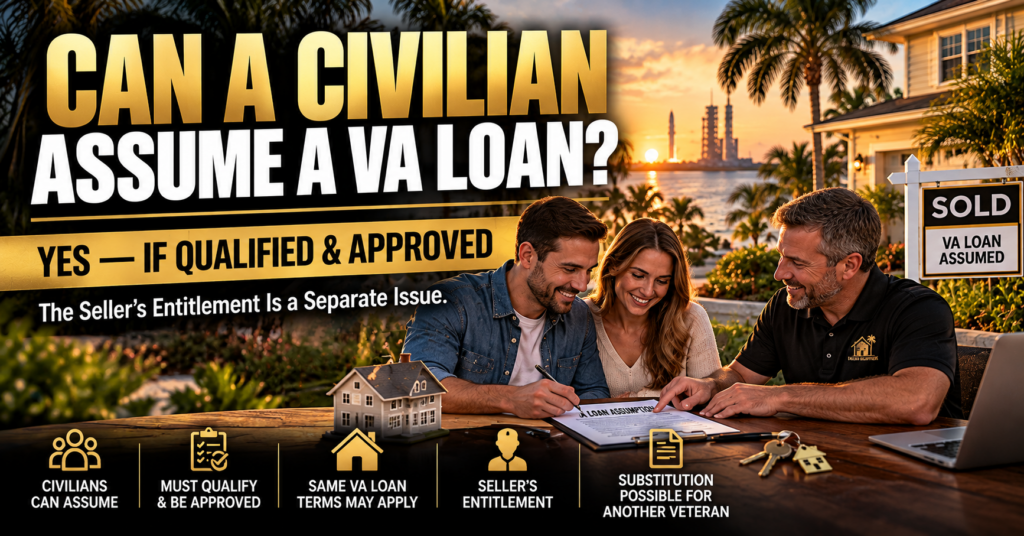
Short answer: yes. A civilian can assume a VA loan. The buyer does not have to be a Veteran, active-duty service member, or otherwise VA-eligible to take over an existing VA-guaranteed mortgage.
VA’s own assumption paperwork says it plainly: any qualified purchaser, including a non-Veteran, may assume the remaining balance of a VA-guaranteed loan.
The part that causes confusion is what happens after the civilian assumes it. The civilian may take over the loan, but the Veteran seller’s VA entitlement generally stays tied to that mortgage unless an eligible Veteran buyer substitutes their own entitlement.
So there are really two separate questions: Can the civilian assume the loan? Yes. Will the seller automatically get VA entitlement back? Usually no.
That second issue is why many Veteran sellers hesitate to offer an assumption—and probably why the myth that VA loans are “Veterans only” has survived so long.
Can a Civilian Assume a VA Loan?
Yes. A civilian buyer can assume a VA-guaranteed mortgage if the assumption is approved and the buyer meets the required credit and income standards.
The Department of Veterans Affairs’ VA Form 26-10291, Assumption Entitlement Acknowledgment, states that any qualified purchaser—including a non-Veteran—may assume the remaining balance of a VA-guaranteed loan.
That is not a loophole. It is part of the VA loan program.
For the broader mechanics, costs, and due diligence involved, start with my VA Assumable Homes for Sale guide.
Why Do So Many People Think Only Veterans Can Assume a VA Loan?
Because two separate VA concepts get mashed together:
- Assuming the mortgage
- Substituting VA entitlement
A civilian can do the first.
A civilian cannot do the second because a civilian does not have VA home-loan entitlement to substitute.
That distinction gets lost surprisingly often—even among people who work in real estate and lending.
If someone says, “Only another Veteran can assume a VA loan,” they are usually confusing loan assumption with substitution of entitlement.
What Changed in 1988?
March 1, 1988 is an important date in VA assumption history, but not because civilians suddenly became allowed to assume VA loans.
VA guidance explains that loans with commitments made before March 1, 1988 are commonly known as freely assumable loans. They could generally be transferred without VA or servicer approval.
For VA-guaranteed loans committed on or after March 1, 1988, assumptions are no longer freely transferable. The assumption generally must be approved, the buyer must satisfy credit underwriting requirements, and the proper release-of-liability process must be completed.
So the modern rule is not “Veterans only.” It is closer to:
Any qualified buyer may assume the loan, but the assumption must be properly approved.
VA’s current assumption guidance uses March 1, 1988 as the dividing line between older freely transferable loans and the modern approval process.
What Does a Civilian Buyer Have to Qualify For?
A civilian does not need military service or a VA Certificate of Eligibility to assume the mortgage itself.
But the buyer still has to qualify for the assumption.
For a modern VA loan assumption, the servicer or authorized holder generally evaluates whether the purchaser:
- Is creditworthy
- Has sufficient income to support the mortgage
- Is contractually assuming the loan obligation
- Meets the servicer’s required documentation standards
- Can bring or finance the required equity gap
- Can pay applicable assumption costs and fees
- Is taking over a loan that is current at closing
In other words, “assumable” does not mean “no underwriting.”
The buyer is stepping into an existing mortgage rather than originating a brand-new first mortgage, but approval still matters.
Does the Civilian Get the Veteran’s VA Benefit?
No.
The civilian is assuming an existing VA-guaranteed loan. They are not becoming VA-eligible and they are not receiving the Veteran seller’s personal VA home-loan benefit.
The loan stays VA-guaranteed according to its existing terms, but the civilian buyer does not suddenly receive VA entitlement.
This matters later because the civilian cannot use VA entitlement to restore the seller’s benefit through substitution.
What Happens to the Seller’s VA Entitlement?
This is the issue Veteran sellers need to understand before agreeing to a civilian assumption.
If a civilian buyer assumes the mortgage and the assumption is properly approved, the seller may receive a release of liability.
But the Veteran seller’s entitlement used on that loan generally remains tied to the mortgage until the loan is paid off or another qualifying restoration event occurs.
A civilian buyer cannot substitute entitlement because the civilian has none to substitute.
I break that issue down separately in VA Loan Entitlement After Assumption: What Happens?.
Release of Liability Does Not Mean Entitlement Restoration
This deserves repeating because it is where the seller’s risk gets misunderstood.
Release of liability means the approved buyer becomes responsible for the mortgage and the seller is released from personal liability for that loan.
Restoration of entitlement means the VA benefit previously charged to that mortgage becomes available to the Veteran again.
A civilian assumption can accomplish the first without accomplishing the second.
The seller can be off the mortgage but still have entitlement tied to it.
Can a Veteran Sell to a Civilian and Still Use a VA Loan Again?
Possibly.
Having entitlement tied to the assumed loan does not necessarily mean the Veteran is completely unable to use a VA loan again.
The seller may still have remaining entitlement. The amount available for another VA-backed purchase depends on the entitlement already charged, the Veteran’s Certificate of Eligibility, the new property location, purchase price, and lender calculations.
This is why I would not tell a seller, “You lose your VA benefit if a civilian assumes the loan.” That is too broad.
A better statement is:
The entitlement tied to that particular loan generally stays tied up, but you may still have remaining entitlement available.
Why Would a Veteran Seller Allow a Civilian to Assume the Loan?
Because the assumable rate may be an extremely valuable selling feature.
A home carrying a 2.5%, 3%, or 3.5% mortgage can attract buyers who might otherwise struggle with the payment at current market rates.
That can potentially:
- Expand the buyer pool
- Create stronger buyer interest
- Help distinguish the property from competing listings
- Support the seller’s negotiating position
- Give a qualified civilian buyer access to financing terms they could not reproduce today
For some sellers, tying up a portion of entitlement may be a reasonable tradeoff.
For others—especially a Veteran planning another VA purchase soon—it may be a deal-breaker.
There is no universal answer. The seller needs to understand the cost of leaving entitlement attached before marketing the assumption as “free money.”
What Is the Equity Gap for a Civilian VA Assumption?
The equity gap is the difference between the agreed purchase price and the remaining balance of the assumable VA loan.
Example:
- Purchase price: $450,000
- Remaining VA loan balance: $310,000
- Equity gap: $140,000
The civilian buyer may love the old interest rate, but still needs to solve that $140,000 difference through cash, sale proceeds, permitted secondary financing, or another acceptable structure.
That is why the low rate alone does not determine whether an assumable property is actually affordable.
For that side of the transaction, see my VA Loan Equity Gap guide.
Does a Civilian Need a VA Certificate of Eligibility?
No—not to assume the loan as a non-Veteran purchaser.
A Certificate of Eligibility becomes relevant when an eligible Veteran wants to use or substitute VA entitlement.
The civilian buyer instead has to satisfy the assumption underwriting requirements imposed by the current loan servicer or authorized holder.
Can a Civilian Assume the Same Interest Rate?
Generally, the appeal of an assumption is that the buyer takes over the existing loan obligation, including the remaining principal balance, interest rate, and remaining term, subject to the approved assumption documents.
That is what makes old VA mortgages potentially valuable in a higher-rate market.
But buyers should verify the exact loan terms directly with the servicer before making financial decisions. MLS remarks are not loan documents.
Can a Civilian Assume a VA Loan With No Down Payment?
Sometimes the equity gap is small enough that the buyer may need relatively little cash beyond closing costs. Other times the gap is enormous.
So “no down payment” is the wrong way to evaluate an assumption.
The more useful question is:
How much money is needed to bridge the purchase price and the assumable loan balance?
A civilian assumption might require $20,000. It might require $200,000.
Same VA loan concept. Completely different transaction.
Can a Civilian Assume a VA Loan Near Patrick Space Force Base?
Yes. The same VA assumption rules apply to eligible assumable properties around Patrick Space Force Base and the broader Space Coast.
This can create interesting opportunities in Satellite Beach, South Patrick Shores, Indian Harbour Beach, Cocoa Beach, Melbourne, West Melbourne, Viera, Palm Bay, and other Brevard County communities where owners may still be carrying VA mortgages originated during much lower-rate years.
A civilian buyer relocating here can potentially benefit from the old rate even without military service.
The seller, however, still needs to understand what happens to their VA entitlement.
For current property searches, see my assumable homes for sale in Brevard County, and for military relocation decisions see my Patrick SFB and Space Coast Military Relocation Guide.
Frequently Asked Questions: Can a Civilian Assume a VA Loan?
Do you have to be a Veteran to assume a VA loan?
No. VA specifically states that any qualified purchaser, including a non-Veteran, may assume the remaining balance of a VA-guaranteed loan.
Can a civilian assume a VA loan from a Veteran?
Yes, if the civilian meets the required credit and income standards and the assumption is properly approved by the authorized loan servicer or VA process.
Does the civilian have to occupy the home?
The standard assumption and substitution-of-entitlement rules are not identical. Occupancy requirements are particularly important when an eligible Veteran buyer is seeking substitution of entitlement. The specific transaction should be confirmed with the loan servicer.
Does the Veteran seller get entitlement back when a civilian assumes?
Generally, no. The seller may receive a release of liability, but the entitlement used on that mortgage generally remains tied to the loan because the civilian has no VA entitlement to substitute.
Can the Veteran seller use another VA loan?
Possibly. The seller may still have remaining entitlement. A lender should review the seller’s current Certificate of Eligibility and calculate what entitlement remains available.
Can a civilian assume a VA loan at the old interest rate?
The existing interest rate and remaining loan term are major reasons buyers pursue assumptions. The exact terms must be verified with the current loan servicer.
Why would the seller prefer a Veteran buyer?
An eligible Veteran buyer with sufficient entitlement may be able to substitute their entitlement for the seller’s. A civilian cannot do that, so a Veteran buyer may offer an important benefit to a seller who wants entitlement restored.
The Part Most People Get Wrong
A VA loan is not “Veterans only” forever just because a Veteran originally used the benefit to obtain it.
A qualified civilian can assume the mortgage.
What the civilian cannot do is substitute VA entitlement for the seller.
That is the real distinction.
If you find a low-rate assumable home on Florida’s Space Coast, I can help break down the property, the likely equity gap, and the real estate questions that need to go back to the servicer before anyone assumes the rate is too good to pass up.
Found a Low-Rate VA Assumption?
Yes, Civilians Can Assume It. Let’s Check Whether the Deal Actually Works.
Send me the property and I’ll help break down the assumable balance, equity gap, seller-entitlement issue, and the questions that need to go back to the servicer.
Call or text: 321-914-2347